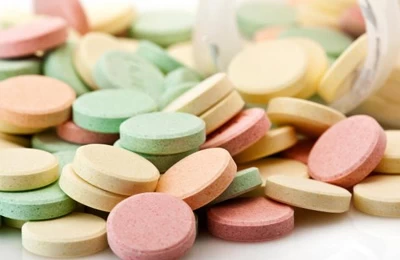
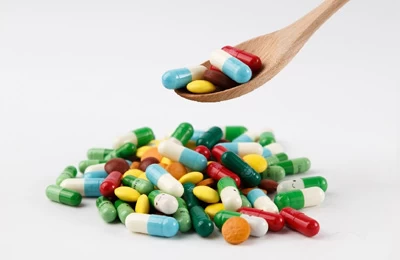
Tablets are tablet-shaped or special-shaped tablet-shaped solid preparations that are uniformly mixed and pressed with drugs and excipients. It is one of the most common oral solid dosage (OSD) of pharmaceuticals and nutraceuticals. They offer several advantages and are easy and cheap to manufacture. Tablets are mainly ordinary tablets that are taken orally. Most of the drugs in these tablets are absorbed through the gastrointestinal tract and act. Some tablets also contain drugs that act locally in the gastrointestinal tract. Oral tablets are divided into the following types:
1. Conventional tablets refer to tablets made by mixing drugs and excipients and compressing them. They are generally swallowed with water, and are also called compressed tablets or plain tablets.
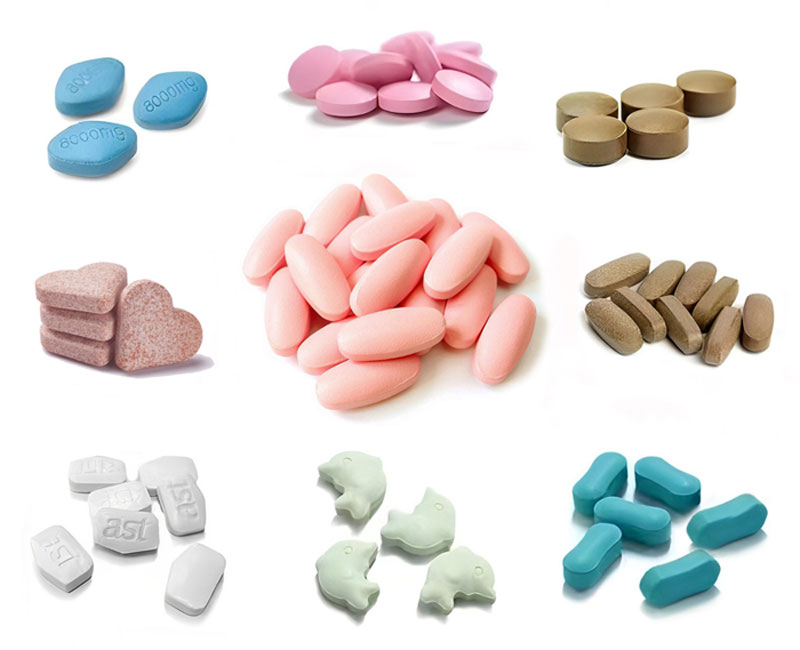
2. Coated tablets refer to tablets with a film coating on the core (compressed tablet). The purpose of coating is to increase the stability of the drugs in the tablets, cover the bad smell of the drugs, improve the appearance of the tablets, etc. Coated tablets can be divided into:
① Sugarcoated tablets refer to tablets mainly made of sugar. Tablets made of coating materials;
② Film-coated tablets refer to tablets that are coated with a film of polymer material;
③ Enteric coated tablets refer to tablets that are coated with a film that does not dissolve in gastric juice. However, the purpose of coating tablets that are soluble in intestinal juice is to prevent the drug from being destroyed in the gastric juice and the drug from irritating the stomach.
3. Multi-layer tablets refer to tablets composed of two or several layers (with different components, formulas or colors). The purpose is to improve the appearance or adjust the action time or reduce the contact of drugs in the two layers and reduce compatibility. changes etc. This kind of tablet can be divided into two or more layers from top to bottom, or can be divided into multiple layers from the center of the tablet outward.
4. Buccal tablets refer to tablets that are held in the mouth and the drug slowly dissolves to produce a long-lasting local effect. The drugs in the lozenges should be easily soluble and mainly have local anti-inflammatory, sterilizing, astringent, analgesic or local anesthetic effects, such as Yinhuang lozenges.
5. Sublingual tablets refer to tablets that melt quickly when placed under the tongue, and the drug is absorbed through the sublingual mucosa and exerts systemic effects. Mainly suitable for emergency treatment.
6. Oral patches refer to tablets that are adhered to the oral cavity and have local or systemic effects after being absorbed through the mucosa, such as metronidazole oral patches.
7. Chewable tablets refer to pastille that are chewed in the mouth and then swallowed. This type of tablet is more suitable for young children. Young children will not swallow tablets. Sugar and suitable spices need to be added to tablets for children to improve the taste. This type of pastille is also suitable for drugs with good compressibility and difficulty in disintegration of the compressed tablets, such as tablets of aluminum bismuthate, aluminum hydroxide, etc.
8. Solution tablets are solutions that are dissolved in water before use. Such tablets are available for oral administration and for other purposes. Oral administration can achieve quick-acting purposes, such as aspirin solution tablets.
9. Effervescent tablets refer to tablets containing effervescent disintegrants. Effervescent tablets can produce gas (usually carbon dioxide) when exposed to water, causing the tablets to rapidly disintegrate. They are mostly used for tablets of soluble drugs, such as Vitamin C effervescent tablets, etc.
10. Dispersion tablets refer to tablets that can quickly disintegrate when placed in warm water, and the drugs are dispersed in the water to form a suspension. This kind of tablet is suitable for infants, young children (when the taste of the medicine is not bitter) and the elderly, and has the effect of quick release.
11. Prolonged action tablets refer to tablets that release drugs slowly and extend the action time.
12. Topical tablets refers to vaginal tablets and compressed tablets designed for preparing external solutions. The former is used directly in the vagina, such as Houttuynia cordata external tablets for the treatment of chronic cervicitis, and Medigon tablets for the treatment of trichomoniasis and trichomoniasis leucorrhea in women. External solution tablets are prepared by adding a certain amount of buffer solution or water to dissolve the tablets to form a solution of a certain concentration, such as Binaide tablets for eye drops, compound borax mouthwash tablets and nitrofuracillin mouthwash tablets for mouthwash. , mercury chloride tablets for disinfection, etc. The ingredients of topical solution tablets must all be soluble.
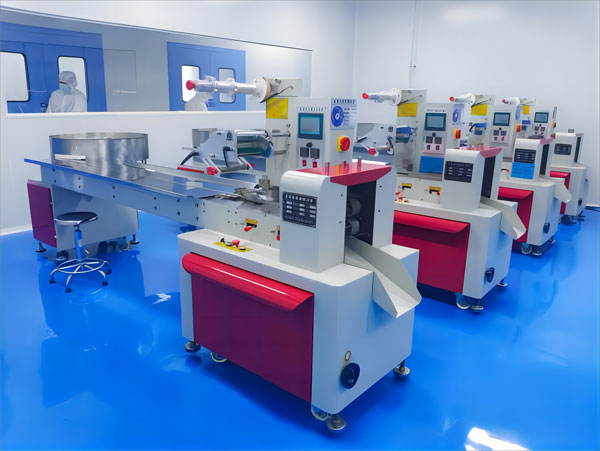
Advantages of Tablets:
Generally, tablets have better dissolution and bioavailability than pills.
The dosage is accurate and the difference in drug content within the tablet is small.
The quality is stable. The tablets are dry solids, and some drugs that are prone to oxidative deterioration and deliquescence can be protected by coating. Light, air, moisture, etc. have little impact on them.
It is more convenient to take, carry and transport.
Mechanized production, large output, low cost, and easy to meet health standards.

+86-13570052379
+86-13570052379
Building 4, No. 11 Tongfu Road, Xicheng Industrial Zone, Xicheng Village, Renhe Town, Baiyun District, Guangzhou City
Custom Supplements