Capsules refer to solid preparations made by filling hollow hard capsules with drugs or appropriate excipients or sealing them in soft capsule materials. They can be divided into hard capsules, softgels (pills), sustained-release capsules, and controlled-release capsules. Capsules and enteric-coated capsules are mainly for oral use.
Gelatin Capsules are the most popular two-section capsules in the world.The capsule consists of two precision-machined capsule shells. There are various sizes of capsules, including 00#, 0#, 1#, 2#, 3#, 4#, and 5# capsules. The larger the number, the smaller the capacity. Capsules can also be colored and printed for a unique, customized look.
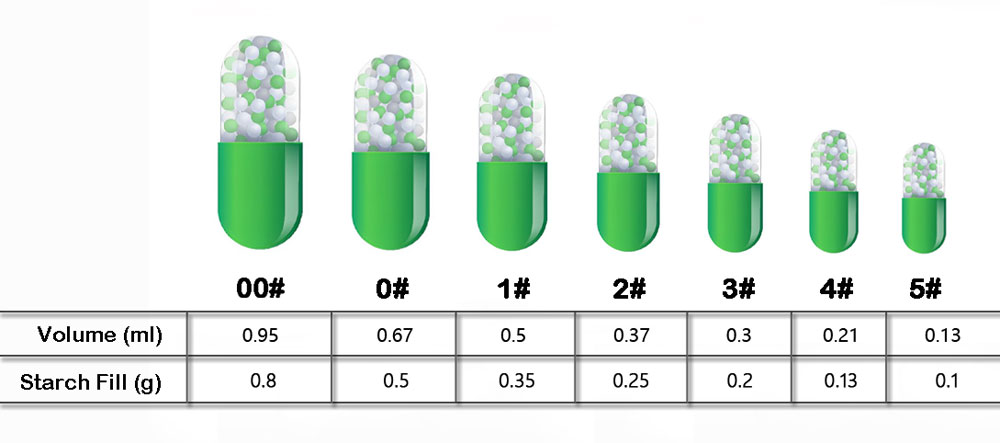
Hard capsules processing refers to making a certain amount of edible raw materials into uniform powder or granules and filling them into hollow capsules. Or directly package raw and auxiliary materials into hollow capsules. According to raw materials, capsules generally include gelatin capsule and plant capsule.The capsule portion has a tapered edge that enables smooth capsule sealing on high-speed filling machines. The double locking ring system allows the capsules to be pre-locked before filling and fully snapped together after filling. The design of the capsule also includes ventilation holes to avoid unnecessary air pressure inside the capsule causing rebound during high-speed filling.
Plant capsules are hollow capsules made of plant cellulose or water-soluble polysaccharides. In addition to their natural conceptual advantages, plant capsules can also improve the absorption and digestion of proteins, fats and carbohydrates, and have features that traditional gelatin capsules do not have. Technical advantages and features. The color of plant capsule shells is mostly transparent, and most of them are lighter in color. It is the best choice for domestic and foreign customers to make high-end products
Softgels is a packaging method for capsules, commonly used in medicines or health foods. It is a capsule made by sealing liquid medicine or liquid solid medicine into a soft capsule material. The soft capsule material is made of gelatin, glycerin or other suitable pharmaceutical excipients alone or mixed in the capsule.
Slow release capsules are a type of drug whose main function is to delay the release, absorption, distribution, metabolism and excretion of drugs in the body to prolong the effects of the drug.
Enteric-coated capsules are capsules that can be dissolved and absorbed in the human small intestine. Hard capsules made by filling capsules with granules or pellets coated with enteric materials, or hard capsules or soft capsules prepared with suitable enteric materials. Special medicinal polymer materials are added to the capsule shell or specially treated to make it insoluble in gastric juice, but can disintegrate in intestinal juice and release active ingredients in the small intestine; capsules for rectal or vaginal administration make Localized release of drugs; drugs to treat enteritis may be mainly absorbed in the colon.
Capsules are a type of solid dosage form widely used in clinical practice, mainly for oral administration. Its main advantages are as follows:
1. Mask taste and improve drug stability. Putting the medicine into the capsule shell can isolate the medicine from the outside world, reduce the influence of air, light and moisture, and have a certain shielding, protection and stabilizing effect on medicines with bad smell and instability.
2. Rapid onset of effect. The drug is filled into capsules with powder or granules. Compared with tablets, pills, etc., the preparation process is not affected by mechanical pressure and other factors, and the drug can be quickly dispersed, dissolved and absorbed in the gastrointestinal tract.
3. Liquid medicine becomes solid. Liquid drugs or drugs with high oil content can be filled into soft capsules to make solid preparations, which are easy to take and carry.
4. Delay or localize the release of drugs. After the drug is made into granules or pellets, suitable coating materials can be selected as needed for coating and put into capsules to make the drug have a sustained release and prolonged effect; enteric-coated capsules can position the drug for release in the small intestine; rectum or vagina The capsules for drug administration can release drugs in a localized manner; drugs for treating enteritis or protein and peptide drugs with the colon as the main absorption site can be made into capsules that release drugs in a colonic position.

+86-13570052379
+86-13570052379
Building 4, No. 11 Tongfu Road, Xicheng Industrial Zone, Xicheng Village, Renhe Town, Baiyun District, Guangzhou City
Custom Supplements